If you manufacture or distribute building materials, fixtures, or sanitary equipment through a network of dealers and service partners, you already know the uncomfortable truth that your brand is only as strong as the nearest authorized reseller. A customer can love your product, trust your engineering, and still walk away, simply because they couldn’t figure out who sells it near them, or who can service it when it breaks.
Key Takeaways-
|
For manufacturers with dozens of subsidiaries and hundreds of distributors spread across multiple countries, this isn’t a minor inconvenience. It’s a structural leak in the sales funnel and one that most CRM systems were never built to fix.
The Problem Isn’t Your Network but the Visibility into It.
Most building materials and sanitaryware companies don’t lack reseller coverage. They lack a way to connect a customer’s location to the right partner in real time. A typical CRM stores reseller records as flat data- a name, an address, a phone number, sitting in a list. There’s no sense of distance, no sense of which partner is actually closest to this specific customer right now.
So, what happens in practice?
- A customer calls a support line or fills out a web form, and
- A sales rep manually scrolls through a spreadsheet or directory, trying to figure out which distributor covers that postcode.
- Sometimes the customer gets routed to a reseller three towns away when a closer one was available.
- Sometimes they give up before they get an answer at all.
Every one of those moments chips away at conversion and trust, especially in an industry where the product is technical enough that customers genuinely need a local expert, not just a transaction.

Location Is a Sales and Service Problem, Not Just a Logistics One
This is where geo-analytics earns its place inside the CRM as core infrastructure for how customers find you and your business!
Consider a customer entering their location, or simply being detected automatically (GPS), and instantly seeing every authorized reseller near them plotted on an interactive map. Not a static list, but a live, geographic view- name, address, working hours, contact details, all attached to a pin they can click. One more click, and they get turn-by-turn directions to the closest one, generated by route optimization rather than a straight-line guess.
That’s the difference between telling a customer you have a partner network and showing them exactly how close it is. It collapses the gap between interest and action, which, in a category where purchase decisions often depend on trust in a local installer or technician, matters enormously.
Radius Search Changes How Service Requests Get Resolved
The same logic applies on the service side, where speed of response often determines satisfaction more than the product itself. With proximity or radius-based search layered onto reseller and service-partner data, a business can instantly filter partners by distance, service type, or availability, not just “who’s in this region” but “who’s closest, right now, and able to help.”
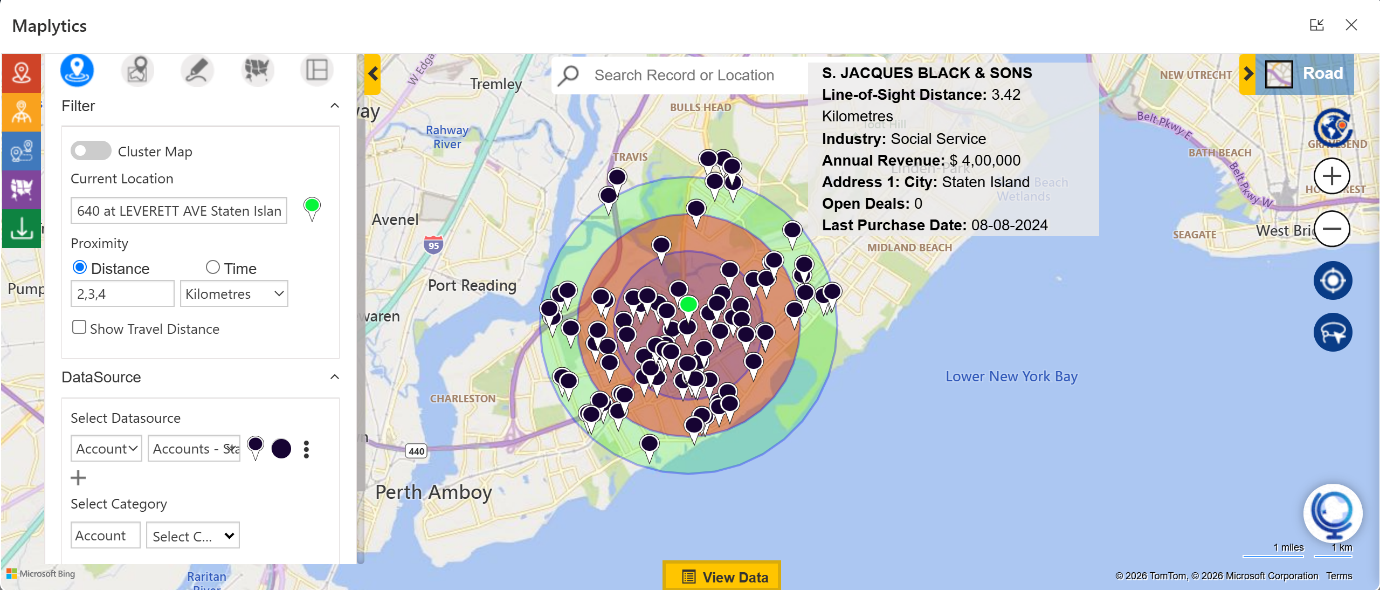
Categorized custom pushpins tied to client geography make this even more precise. Instead of a generic directory, the system links each service partner’s location directly to the surrounding customer base, so when someone searches, they’re not sorting through irrelevant results but seeing only the partners who can realistically serve them.
The operational impact compounds quickly.
- Faster response times, because customers reach the nearest qualified partner instead of working through a directory.
- Higher conversion, because customers are guided to a trusted, verified reseller rather than abandoning the search.
- Stronger brand consistency, because every customer interaction, regardless of country or subsidiary, routes through the same accurate, location-aware system.
- Better partner engagement, because resellers and service technicians get matched to demand near them, instead of competing for visibility in a flat list.
What This Means If You’re Running a Distributed Dealer Network
If your business sells through subsidiaries, importers, or independent resellers across multiple regions, the question worth asking isn’t whether your network is large enough. It’s whether your systems can actually see it geographically, and whether your customers can see it too.
Location intelligence inside your CRM doesn’t replace your dealer network. It makes the one you’ve already built actually usable by turning a static list of addresses into a live map of trust, proximity, and service availability. In an industry built on long-term reliability and local expertise, that’s not a minor feature. It’s the difference between a customer finding you or finding someone else first.
What’s More?
If you wish to combine maps, routes, schedules, and real-time updates to make a difference, Maplytics with MapCopilot, its AI assistant, is available immediately for Dynamics 365, Power Apps, Power Pages, and Dataverse. Organizations interested in adoption, 15-day free trials, or personalized demos are encouraged to contact Maplytics’ sales team at crm@inogic.com
For more information, visit our website or Microsoft Marketplace. One can hop onto the detailed Blogs, Client Testimonials, Success Stories, Industry Applications, and Video Library for a quick query resolution. Technical docs for the working of Maplytics are also available for reference.
Please leave us a review or share your experience on the Microsoft Marketplace or the G2 Website.