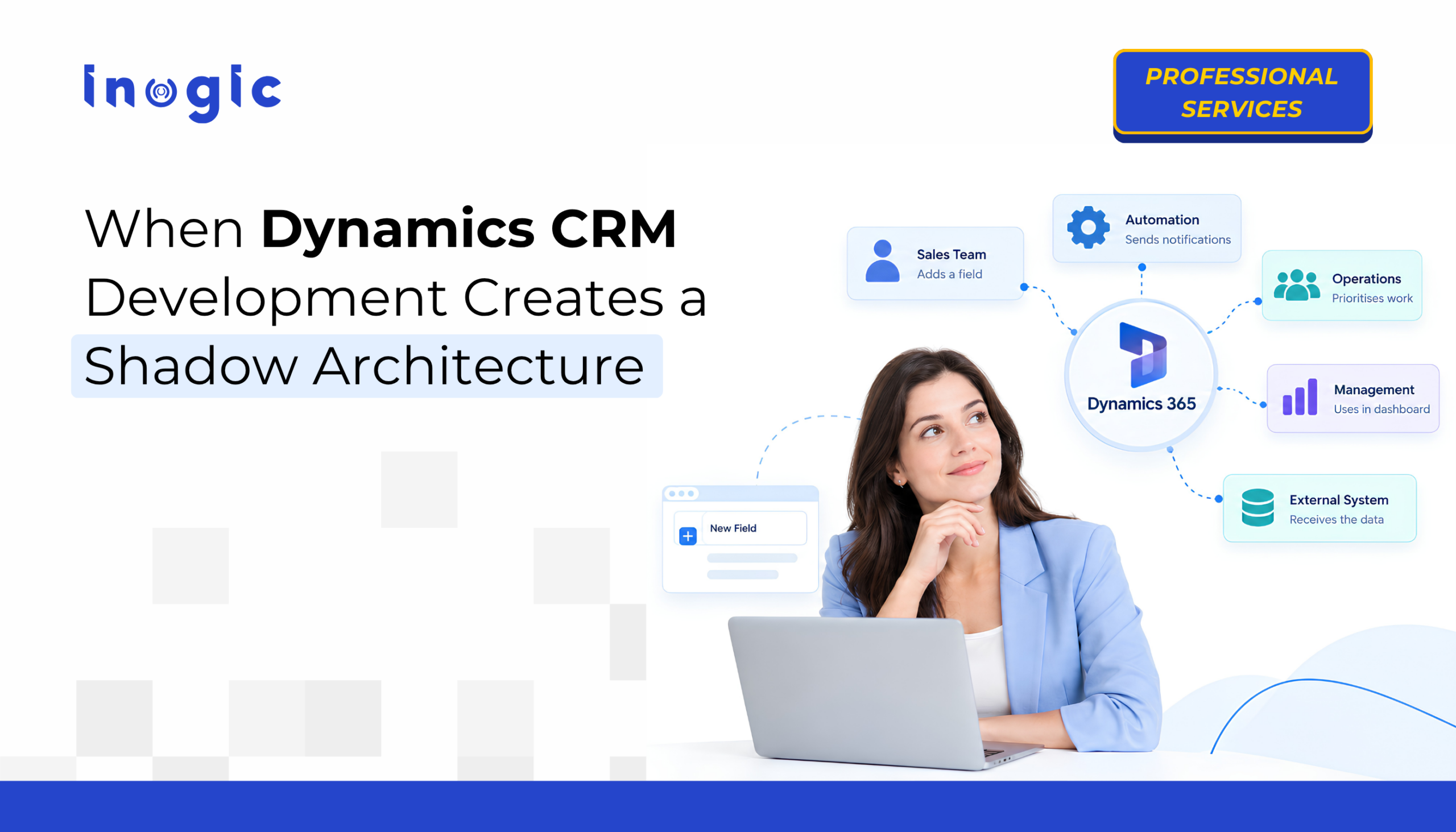
A sales team requests one additional field in Dynamics 365. Later, an automation uses that field to send notifications. Operations begins relying on the information to prioritise work. Management adds it to a dashboard. Another system eventually receives the data.
Nobody planned to build a new business-critical process. Yet removing that original field could now disrupt several teams.
This is how a shadow architecture develops: not through one poor technology decision, but through a series of sensible decisions that gradually become connected infrastructure.
Key Takeaways
- Small Dynamics 365 CRM customizations and temporary solutions can gradually form a hidden, business-critical architecture.
- A workaround becomes infrastructure when teams, processes, or systems depend on it.
- Hidden dependencies can make changes difficult without proper documentation and technical oversight.
- Reviewing existing solutions before adding new functionality helps reduce unnecessary complexity.
- Ongoing Dynamics 365 expertise can help businesses maintain and evolve an increasingly complex CRM environment.
The Workaround-to-Infrastructure Threshold in Dynamics CRM Development
Every temporary solution does not require extensive governance. The challenge is recognising when it stops being temporary.
A solution crosses the threshold when other people, processes, or systems begin depending on it.
Ask one practical question: What would happen if this disappeared tomorrow?
If one employee loses a convenience feature, it is probably still a workaround. If several teams cannot complete their work, reports become unreliable, or downstream processes fail, it has become infrastructure.
That distinction is often missed during Dynamics CRM development. Teams focus on whether the requested functionality works, while the long-term impact of that functionality develops gradually.
The Three Stages of Shadow Architecture
1. The Useful Fix
A customization solves a specific problem for one team. It has a clear purpose and limited impact.
2. The Unofficial Dependency
Other teams discover the solution and begin using its data or output. Automations, reports, and processes start depending on it.
3. The Hidden Infrastructure
The solution becomes difficult to change because nobody fully understands what depends on it. It may be business-critical, yet ownership and documentation remain incomplete.
This is where a small change can become part of a much larger architecture without ever being formally designed as one.
Why Adding More Features Can Create a Shadow Architecture
Growth is not always visible in the number of applications a business owns. It can happen inside existing platforms.
Over time, organizations may accumulate custom entities, workflows, integrations, plug-ins, and automations. Each one may be valuable. The problem emerges when nobody understands the complete chain between them.
For example, changing a field may appear simple until that field triggers an automation, feeds a report, and supports another business process.
This is why Dynamics CRM development services should begin with context. Building the requested functionality matters, but understanding what already depends on the environment matters equally.
The Questions a Dynamics 365 Technical Consultant Should Ask
Before adding another solution, businesses should ask:
- Does similar functionality already exist?
- Who owns the current process?
- Which teams depend on it?
- What systems exchange information with it?
- Is configuration sufficient, or is custom development necessary?
- How will the solution be maintained?
These questions can prevent a temporary fix from becoming another undocumented dependency.
From Shadow Architecture to Intentional Technology
The answer is not to stop customizing. Businesses need flexibility as their processes change. The objective is to make accumulated technology visible before complexity becomes difficult to manage.
This may involve reviewing existing customizations, documenting dependencies, consolidating overlapping functionality, and assigning ownership for business-critical solutions.
For organizations with an evolving CRM environment, Dynamics 365 managed services can provide useful continuity beyond a single development project. Inogic can support businesses that need ongoing technical attention to understand, maintain, and evolve their Dynamics 365 environment.
FAQs
What is shadow architecture in Dynamics CRM development?
Shadow architecture develops when customisations, workflows, and integrations gradually become connected without being planned as one complete system.
When do businesses need Dynamics 365 development services?
Businesses may need Dynamics 365 development services when existing processes require custom functionality, integrations, or changes that cannot be handled effectively through standard configuration.
How can a Dynamics 365 technical consultant reduce hidden dependencies?
A Dynamics 365 technical consultant can review existing customisations and processes to identify dependencies before new changes create additional complexity.
Why can Dynamics CRM development become difficult to maintain?
Dynamics CRM development can become harder to maintain when multiple solutions are added over time without clear documentation, ownership, or an understanding of how they depend on one another.
When should a business consider Dynamics 365 managed services?
Dynamics 365 managed services can be useful when an organisation needs ongoing technical support to maintain, monitor, and evolve an existing Dynamics environment.