 Field operations look simple from the outside.
A sales rep or technician receives a list of customers à drives to their locations à finishes the visits à and updates the CRM.
On paper, this process appears straightforward. If dug deeper, it turns out to be one of the most complex and overlooked areas of business operations.
What many organizations ignore is that inefficient routing quietly drains productivity, revenue, and morale. The cost of poorly planned routes rarely appears in financial reports as a single line item. Instead, it hides across
- fuel bills,
- delayed meetings,
- employee fatigue, and
- missed opportunities.
For companies managing field teams, the real question is how much bad routing is costing the business every single day.
The Cost of Wasted Fuel
Fuel expenses are often the most visible cost of inefficient routes. However, even here, the damage is often underestimated.
Consider a typical field representative who visits six to eight clients per day. If those visits are planned manually without considering geographic proximity, the rep may end up traveling across the same city multiple times. A meeting in the north of the city à might be followed by one in the south, à only to return north again later in the day.
This kind of route pattern unnecessarily increases the total distance traveled. Even a small increase in daily mileage adds up quickly.
If a field rep drives an additional 20 kilometers per day due to poor route planning, that becomes over 5,000 extra kilometers per year.
 Multiply that across an entire field team, and the numbers grow rapidly. For an organization with 50 field representatives, inefficient routing could easily translate into hundreds of thousands of additional kilometers driven annually.
The financial impact goes beyond fuel alone. More driving also means:
- Increased vehicle maintenance
- Higher insurance and operational costs
- Faster vehicle depreciation
Fuel wastage is an environmental concern and also a direct operational inefficiency that quietly increases the cost of field management.
The Cost of Late Meetings
Time is the most valuable resource for any field team. When routes are poorly planned, travel time becomes unpredictable. Traffic congestion, longer distances, and unnecessary backtracking often cause delays.
A sales rep who planned four meetings in a day may find the schedule collapsing after the first delay. If the first appointment runs late because the rep had to travel across town during peak traffic hours, the second meeting may start late as well.
This creates a chain reaction throughout the day.
Clients notice delays quickly. When a representative arrives late, it sends a subtle but powerful signal about reliability. Even if the delay is caused by traffic, the client experiences it as poor planning.
In competitive industries, punctuality often plays a role in building trust. A late arrival can reduce the time available for meaningful discussion and weaken the overall client experience.
For field service teams, delays can be even more problematic. A technician arriving late to a scheduled maintenance appointment disrupts the client’s operations and affects service-level agreements.
In both cases, poor routing wastes time and damages the perception of professionalism and reliability.
The Cost of Tired Sales Representatives
Driving for long hours is more exhausting than many organizations realize. When routes are inefficient, field representatives spend more time on the road than necessary. Long drives between appointments can reduce both physical energy and mental focus.
By the time a rep arrives at the final meeting of the day, fatigue may already be affecting their performance.
A tired sales rep is less likely to deliver a compelling product demonstration, handle objections effectively, or engage in meaningful conversation with the customer. The quality of interaction gradually declines as the day progresses.
 This fatigue also affects long-term employee morale. Spending hours navigating traffic instead of meeting customers can make field work frustrating.
High travel stress often leads to:
- Lower job satisfaction
- Reduced motivation
- Higher employee turnover
Recruiting and training new field representatives is expensive. When inefficient routing contributes to employee burnout, the organization absorbs additional hidden costs.
Efficient field management is not only about productivity. It is also about protecting the well-being and motivation of the people who represent the company in the field.
The Cost of Lost Deals
Perhaps the highest hidden cost of poor routing is the loss of potential business opportunities.
Field representatives have limited hours in a day. Every extra hour spent driving is an hour not spent engaging with customers.
When schedules are unplanned & routes are inefficient, the number of client visits per day decreases. A rep who could have visited six customers might only manage four because of excessive travel time.
This directly affects pipeline growth and revenue potential.
Missed opportunities occur in several ways:
- Fewer customer visits per day
- Reduced time spent building relationships
- Inability to respond quickly to new leads in nearby areas
In many industries, the speed of response plays a critical role in closing deals. If a new lead appears within a sales rep’s territory but the rep’s route is already inefficiently planned, the opportunity may be delayed or missed entirely.
Competitors with better field coordination may reach the customer first.
Over time, these small inefficiencies accumulate and create a noticeable gap in sales performance.
The Turning Point- ‘Smarter Route Optimization’
The good news is that modern location intelligence tools have made it possible to address these challenges with precision.
Optimized Routing in Dynamics 365 analyzes several factors simultaneously to create the most efficient travel plan for field teams. Instead of manually sequencing appointments, route mapping in Dynamics 365 calculates the best order of visits based on geographic distance, travel time, and real-world road conditions.
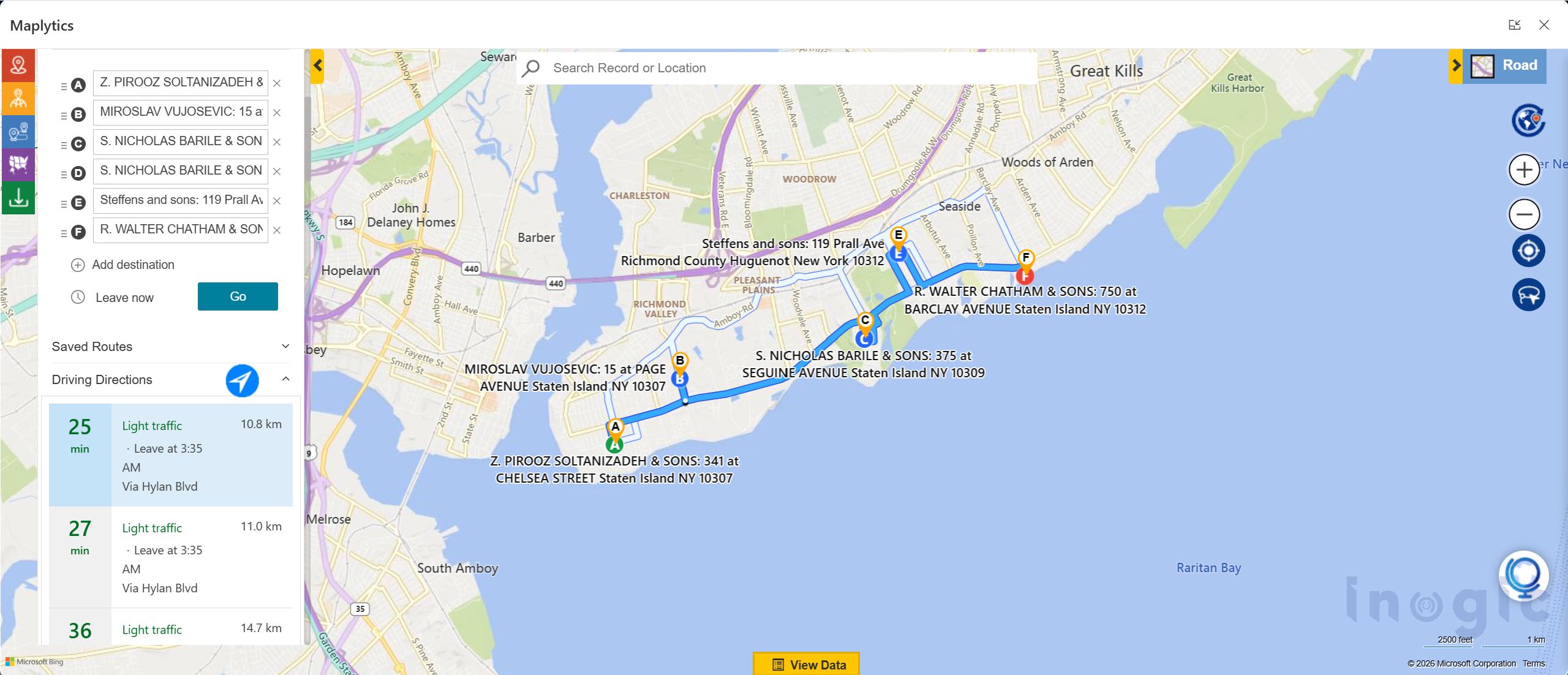 By evaluating these variables, route mapping ensures that field representatives follow the most efficient path between customer locations.
This brings immediate operational benefits.
- Fuel consumption decreases because unnecessary travel is eliminated.
- Meetings become more punctual because routes account for realistic travel time.
- Field representatives experience less fatigue since they spend less time driving.
- Most importantly, teams can visit more customers in a single day.
In a modern CRM environment, route optimization becomes even more powerful when combined with location intelligence. Customer records, leads, and service requests can be visualized directly on maps. Field teams can identify nearby opportunities and integrate them into their routes without disrupting the day’s schedule.
Tools like Maplytics bring this capability directly into platforms such as Microsoft Dynamics 365. With features like route optimization, territory visualization, radius search, and intelligent automated scheduling in Dynamics 365, field teams can transform raw CRM data into actionable travel insights and relevant plans.
Instead of manually guessing the best route, representatives receive a data-driven travel strategy that maximizes productivity.
Smarter Routes Lead to Smarter Field Management
Field operations often determine how efficiently a company engages with its customers. While organizations invest heavily in sales strategies and marketing campaigns, the logistics of reaching customers sometimes receive less attention.
Yet the reality is clear. Poor routing silently drains resources across fuel expenses, employee productivity, customer experience, and revenue potential.
When businesses adopt route optimization as a core part of field management, they gain more than just better travel paths. They gain a more productive workforce, a more reliable service experience, and a stronger ability to respond to opportunities in real time.
The difference between an average field team and a highly efficient one often lies in a simple question.
Are their routes planned by guesswork or by intelligent location data?
What’s more?
If you wish to combine maps, routes, schedules, and real-time updates to make a difference, Maplytics with MapCopilot, its AI assistant, is available immediately for Dynamics 365, Power Apps, Power Pages, and Dataverse. Organizations interested in adoption, 15-day free trials, or personalized demos are encouraged to contact Maplytics’ sales team at crm@inogic.com
For more information, visit our website or Microsoft Marketplace. One can hop onto the detailed Blogs, Client Testimonials, Success Stories, Industry Applications, and Video Library for a quick query resolution. Technical docs for the working of Maplytics are also available for reference.
Kindly leave us a review or write about your experience on the Microsoft Marketplace or the G2 Website.