
If your CRM contains multiple versions of the same customer, you don’t just have a data issue; you have a revenue, experience, and AI-readiness problem.
Sales teams lose confidence in pipelines.
Marketing struggles with audience accuracy.
And AI tools like ChatGPT, Microsoft Copilot, Gemini, etc., can’t deliver reliable insights without unified customer profiles.
This FAQ-style guide explains how modern Dynamics 365 teams build clean, unified, AI-ready CRM data using intelligent duplicate matching rules, fuzzy identity resolution, governed merge rules, and continuous data governance.
What does duplicate data really mean in Dynamics 365?
Duplicate data exists when two or more CRM records represent the same real-world customer, account, or contact, even if the values look different.
A modern CRM approach resolves this by continuously identifying related records across Leads, Contacts, Accounts, and even custom entities, then consolidating them into a single trusted identity while preserving full history.
Instead of treating duplicates as isolated cleanup tasks, CRM is designed for data deduplication to automatically maintain unified customer profiles, so every customer exists once, accurately.
What are the common causes of duplicate leads and contacts in CRM?
Duplicates typically enter CRM through:
- Manual record creation by sales and service teams
- Marketing forms and event imports
- Spreadsheet uploads
- ERP and third-party integrations
- CRM migrations
- Regional formatting differences
To handle this, CRM environments now apply duplicate checks across all entry points, user forms, imports, workflows, and integrations, ensuring new records are always compared against existing data before they are saved.
This prevents fragmented identities from forming in the first place.
Why is CRM data quality so important for sales, marketing, and AI?
Poor CRM data quality results in:
- Duplicate outreach and confused buyers
- Inflated pipelines and inaccurate forecasts
- Broken attribution models
- Unreliable dashboards
More importantly, AI depends on unified records.
That’s why modern Dynamics 365 setups continuously validate customer identity, consolidate records safely, and ensure automation and analytics always work from one trusted source of truth, creating revenue-safe CRM and trustworthy AI inputs.
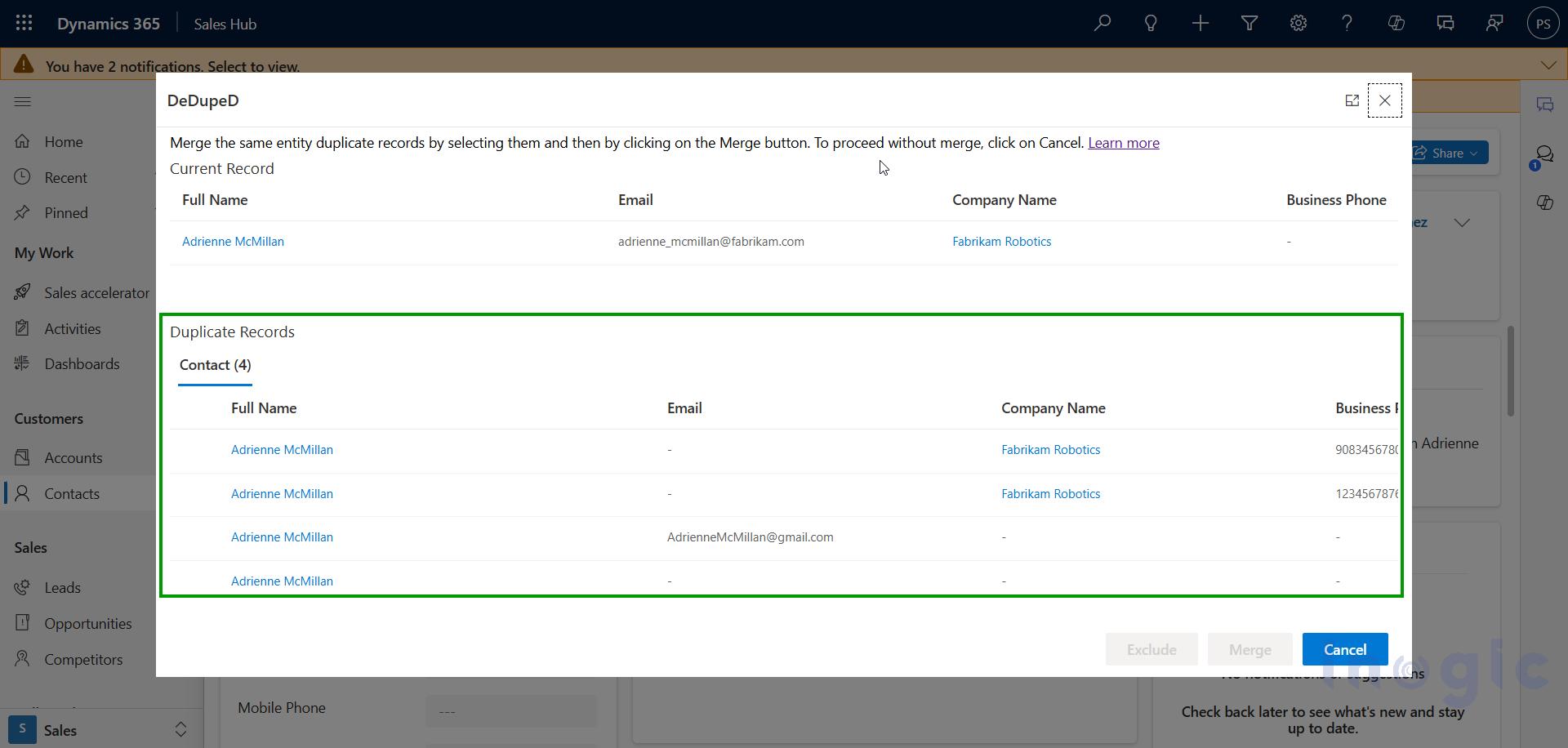
How do I identify duplicate records when they don’t look identical?
Exact matches are no longer enough.
Modern CRM platforms use multiple duplicate identification techniques together:
- Partial matching for similar text
- Phonetic fuzzy matching for sound-alike names
- Multi-field comparison (name + email + company)
- Format-aware matching for phone numbers and addresses
These techniques run both:
- In real time, while users create or edit records
- In the background for imports, integrations, and automation
This allows CRM to recognize the same customer even when data is inconsistent, enabling true identity resolution.
What are duplicate matching rules, and why do they matter?
Duplicate matching rules define where CRM should look for duplicates.
For example:
- Should Leads be compared with Contacts?
- Should Accounts only be matched with Accounts?
- Should new records always be checked against existing ones?
By configuring matching rules per entity, CRM ensures the right datasets are compared, which is essential for building a single customer view in Dynamics 365.
These rules run continuously, so identity is resolved not just once, but throughout the CRM lifecycle.
What are duplicate matching conditions?
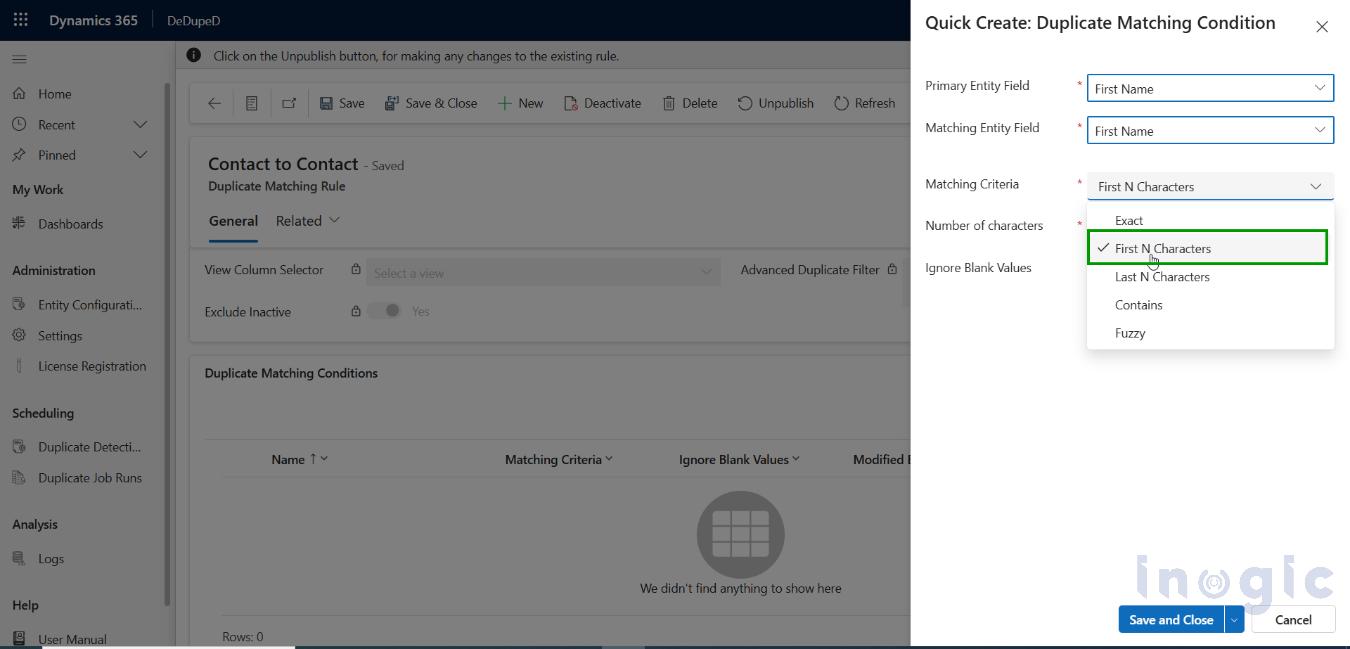
Matching conditions define how CRM evaluates similarity.
Instead of relying on one field, CRM combines:
- Name similarity
- Email patterns
- Phone numbers
- Company attributes
Conditions also control:
- How strict matching should be
- Whether sound-alike values count
- How much variation is acceptable
Together, duplicate matching rules and conditions teach CRM how your business recognizes customers, forming the foundation of CRM data quality and unified customer profiles.
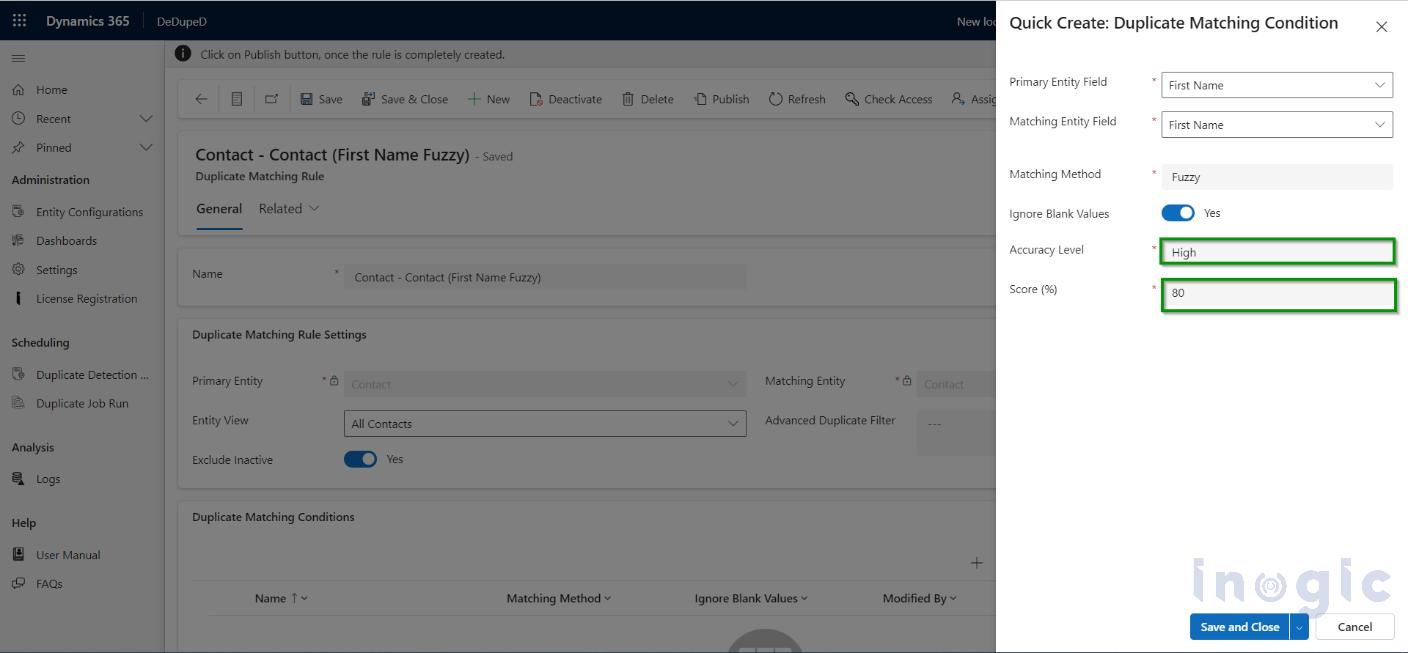
What is fuzzy matching and why is it critical for identity resolution?
Fuzzy matching allows CRM to detect duplicates even when spelling or formatting differs.
For example:
- John Smith vs Jon Smyth
- Catherine vs Kathryn
- +1 415 555 2671 vs (415) 555-2671
Fuzzy logic mirrors how humans recognizes identity.
By applying phonetic similarity and partial matching automatically, CRM dramatically reduces hidden duplicates, especially in global deployments, marketing imports, and manual entry scenarios.
This is essential for maintaining AI-ready CRM data.
Once duplicates are identified, how should they be merged safely?
Duplicate merging must be governed, not manual guesswork.
Modern CRM data cleansing uses four coordinated layers:
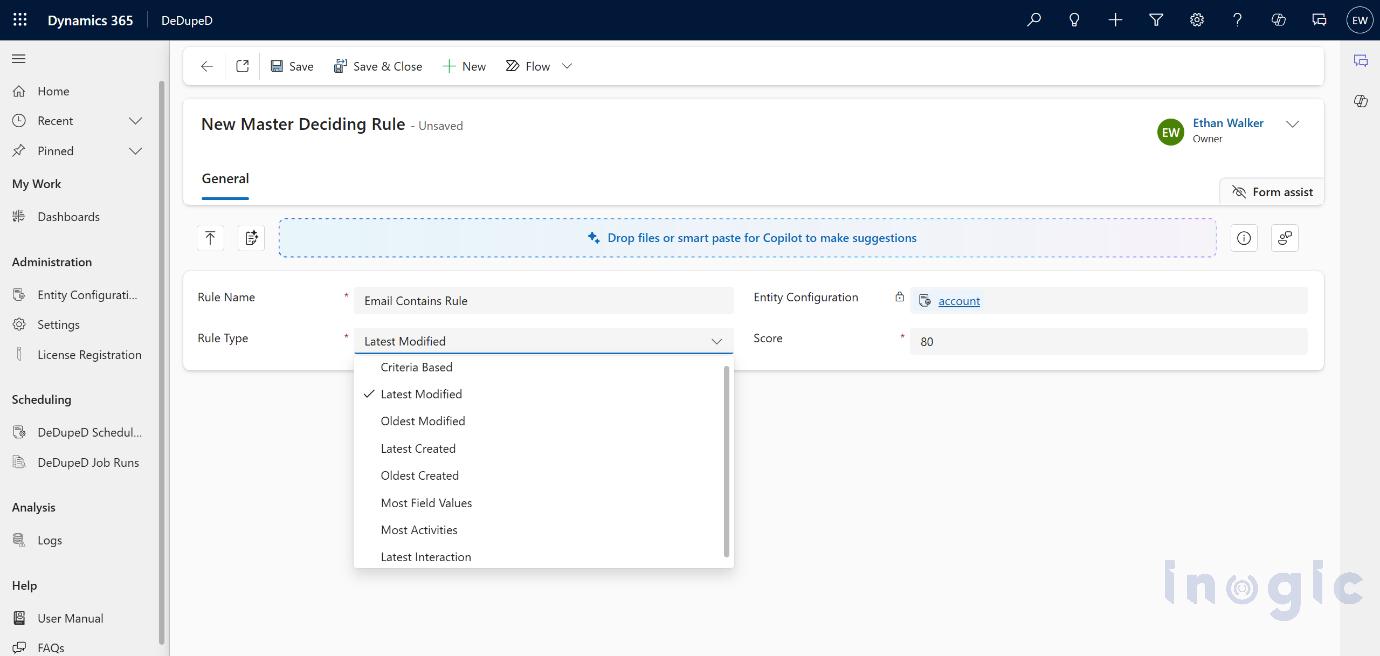
1. Intelligent Master Record Selection
CRM automatically determines which record survives based on:
- Data completeness
- Recent activity
- Ownership or trusted source
- Weighted scoring across multiple criteria
This ensures the most reliable record becomes the master, consistently and transparently.
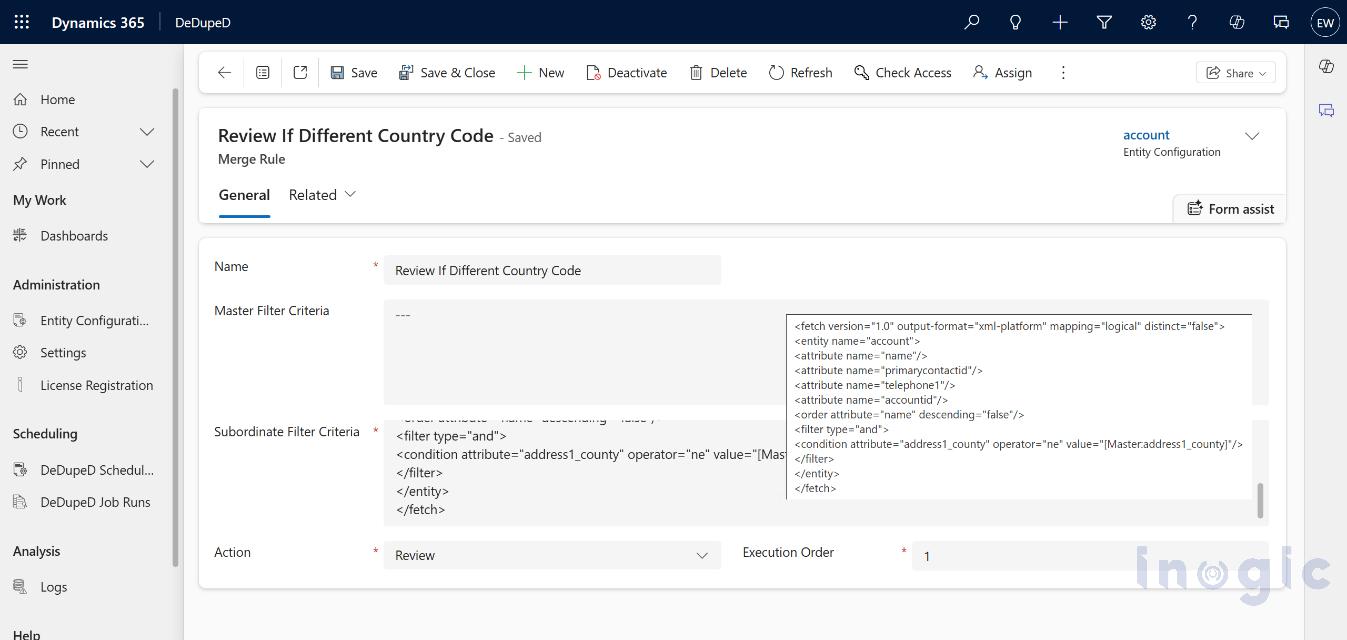
 2. Merge Rules and Conditions
Not every duplicate should merge automatically.
Merge rules decide whether records should:
- Merge automatically
- Be sent for review
- Be blocked entirely
This protects sensitive or business-critical data and supports compliance-ready CRM.
3. Field-Level and Address-Level Merge Logic
Different data types merge differently:
- Text fields can be appended
- Numeric values summed
- Picklists retain dominant values
- Addresses follow structured merge strategies
This guarantees the right information survives consolidation.
Activities, notes, opportunities, cases, and child records are rolled up to the master record, maintaining complete customer history.
The outcome is simple: One customer. One history. One trusted record.
What is duplicate merging and how does it support single customer view?
Duplicate merging consolidates multiple records into one unified profile while preserving relationships and history.
When governed correctly, it delivers:
- Unified customer profiles
- Accurate reporting
- Reliable automation
- Clean records for analytics
- AI-ready CRM data
This is how organizations achieve Customer 360 and operationalize single customer view CRM.
How do I prevent duplicates from entering CRM again?
Long-term CRM data integrity depends on prevention at the source:
- Validate records during user entry
- Apply duplicate checks during imports and integrations
- Monitor CRM on a defined schedule
- Allow only authorized users to override warnings
- Assign ownership for CRM data governance
This transforms CRM data cleansing from reactive cleanup into a continuous discipline.
How do matching rules and merge rules work together?
They form a complete identity governance framework:
- Matching rules decide where duplicates are checked
- Matching conditions decide how similarity is evaluated
- Merge rules decide what happens next
- Master selection chooses the surviving record
- Merge logic preserves the correct data
Together, they enable identity resolution, CRM data integrity, and revenue-safe CRM operations.
How do I prepare Dynamics 365 for AI tools like Copilot and ChatGPT?
AI tools like ChatGPT, Copilot depends on:
- Unified customer identities
- Clean, validated records
- Governed merging
- Continuous duplicate prevention
Without these, AI simply amplifies fragmented data.
Preparing CRM for Copilot starts with building clean, unified, AI-ready CRM data, not with prompts or dashboards.
Final Thoughts: CRM Data Quality Is Now a Business Strategy
By 2026, leading organizations no longer manage duplicates.
They manage:
- Identity resolution
- Duplicate matching rules and conditions
- Fuzzy matching
- Merge rules and master selection
- Governed duplicate merging
- Continuous CRM data governance
This is how they protect revenue, enable trustworthy AI, and deliver consistent customer experiences in Dynamics 365.
Bringing It All Together: One Platform for Clean, Unified, AI-Ready CRM Data
Throughout this guide, we’ve covered what modern Dynamics 365 teams need to maintain high CRM data quality in 2026:
- Intelligent duplicate identification across users, imports, and integrations
- Flexible duplicate matching rules and matching conditions that reflect real business logic
- Fuzzy matching for accurate identity resolution when data doesn’t look identical
- Governed merge rules that decide when records should merge, be reviewed, or blocked
- Automated master record selection based on completeness, activity, and scoring
- Field-level and address-level merge logic to preserve the right information
- Relationship-aware duplicate merging to maintain full customer history
- Continuous prevention and monitoring to stop bad data from re-entering CRM
- A foundation that supports a single customer view, Customer 360, and AI-ready CRM data
Individually, these capabilities solve parts of the problem.
Together, they create a complete CRM data governance framework, one that ensures every lead, account, and contact exists as one trusted identity, so sales teams, marketing automation, analytics, and Copilot can all work with accurate, unified data.
This is exactly what DeDupeD delivers for Dynamics 365.
Rather than acting as a one-time cleanup utility, DeDupeD serves as an AI-Ready Data Foundation for Dynamics 365, bringing all of the above requirements into a single, governed platform:
- It identifies duplicates using intelligent matching rules and fuzzy identity resolution
- It applies business-driven merge rules with automatic master selection
- It safely consolidates records while preserving fields, addresses, and relationships
- It prevents duplicates at every entry point — users, imports, workflows, and integrations
- It continuously monitors CRM to maintain long-term data integrity
The result is not just fewer duplicates.
It’s clean records, unified customer profiles, compliance-ready data, and a true single customer view, giving organizations confidence that their CRM is revenue-safe, trustworthy for AI, and ready for the future.
In short:
DeDupeD ensures Dynamics 365 operates on clean, unified, AI-ready CRM data, so every customer exists once, every insight is reliable, and every team can trust the system they work in.
Experience the next generation of DeDupeD in our first-ever webinar, where we’ll walk you through an end-to-end data deduplication journey, from real-time duplicate identification to intelligent merging—so you can create clean, unified, AI-ready CRM data.
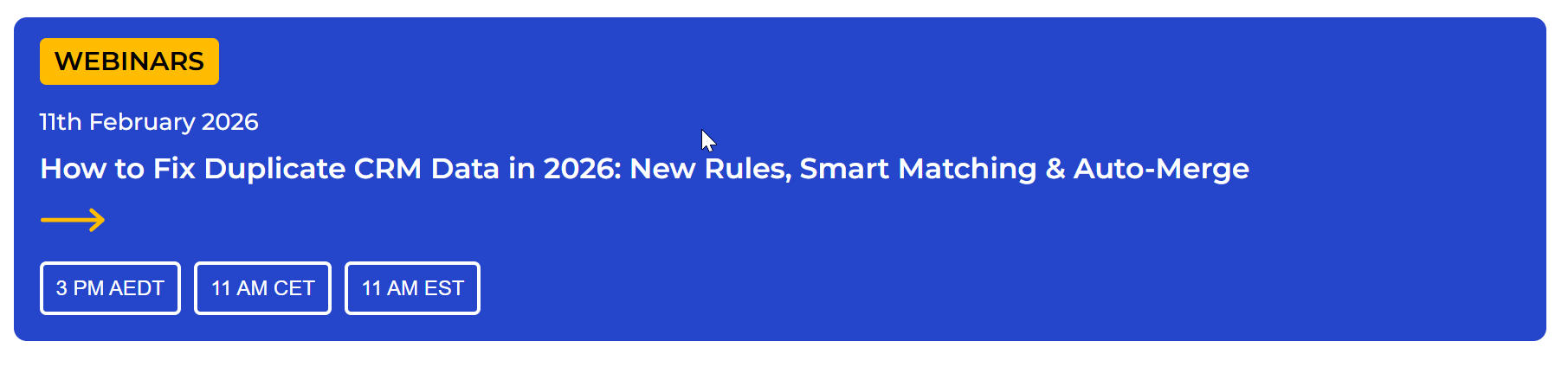
⏳ Can’t join us live? No problem, register anyway and we’ll send you the complete recording so you can watch it when it suits you.
Start your 15-day free trial from the Inogic website or via the Microsoft Marketplace.
Prefer a personalized walkthrough? Reach out to us at crm@inogic.com, our CRM experts are happy to guide you and answer all your questions.